
by Johnny Chen
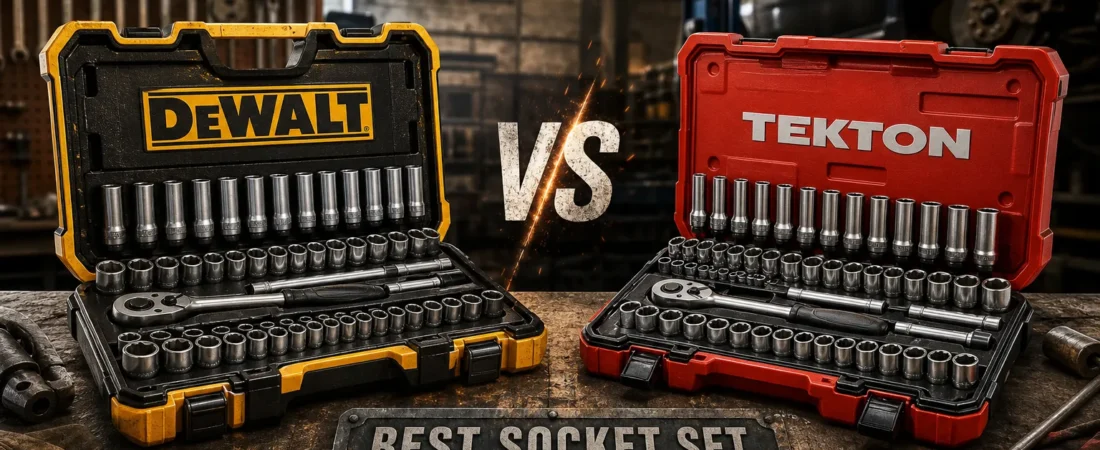
You’re standing in the tool aisle at Home Depot, or it’s midnight and you’re on Amazon with a browser tab open for each brand, and you need to pick one. If you’re weighing a DeWalt vs Tekton socket set for home mechanics, the decision comes down to more than price, though the price gap between them is real enough to make you pause. Both show up on every “best socket set” list. Both have respectable reviews. That gap is worth examining, not just accepting.
Here at On the Rise, we don’t play brand favorites. We’re not here to help a manufacturer move units. We’re here to help you spend your money right, which sometimes means the more affordable option wins, and sometimes the premium pick is worth every extra dollar. This breakdown covers price, materials, real-world durability, warranty, and clear recommendations by use case so you can close this tab and order with confidence.
Price and what you actually get in the box
DeWalt’s socket lineup runs across several tiers. The DWMT72163 (118-piece) lands around $149.99 and covers 1/4″ and 3/8″ drives. Step up to the DWMT72164 (156-piece) and you’re at roughly $199.99 for more coverage across those same two drives. The flagship DWMT72165 is a 204-piece set at around $299.99, the one that brings all three drive sizes: 1/4″, 3/8″, and 1/2″. DeWalt also sells focused sets, the DWMT45422 for 1/4″ drive and DWMT45423 for 3/8″, if you’re not ready to commit to a full combo kit. All of that puts DeWalt squarely in the mid-to-premium range compared to the broader socket market.
Tekton’s pricing varies considerably by configuration, and the “budget brand” label doesn’t hold across the board. Their 3/8″ drive SKT15311 (73-piece) lists around $175, competitive with DeWalt’s mid-tier options, while their 212-piece combo set covering all three drive sizes sits closer to $475, which is actually higher than DeWalt’s comparable DWMT72165 at around $299.99. That larger Tekton set includes more sockets per drive size, which accounts for some of the price difference, but it also reflects Tekton’s positioning as a quality-focused brand rather than a pure budget play. Where Tekton more consistently earns its value reputation is in size coverage: the SKT15311 alone includes 73 sockets across SAE shallow, SAE deep, metric shallow, and metric deep ranges, which is comprehensive for that price point.
On a cost-per-piece basis, Tekton can offer better value on many individual configurations, but this isn’t universal across all set sizes and models. Piece count alone doesn’t make a socket set useful anyway. What matters is whether the sizes included actually match the fasteners you’ll encounter. For home mechanics doing oil changes, brake jobs, and basic suspension work, you need 10mm, 12mm, 14mm, 17mm, 19mm, and 21mm in metric, plus common SAE sizes from 3/8″ through 7/8″. Both brands cover this ground in their popular sets. The question is what else you’re getting for the price difference.
Build quality: steel, finish, and how sockets hold up under pressure
Standard hand socket materials: DeWalt vs Tekton socket set construction
Both DeWalt and Tekton standard hand sockets are built from chrome-vanadium steel with a polished chrome finish. That’s the same baseline material, and it’s entirely appropriate for hand-tool use in a home garage. Chrome-vanadium typically falls in the 58, 62 HRC Rockwell hardness range for quality socket production, and both brands meet that standard. The finish provides adequate rust resistance for typical conditions, and neither brand holds a significant edge at this level.
Where the material story gets more interesting is impact sockets. Tekton’s impact lineup uses chrome-molybdenum steel with a black phosphate coating. Chrome-moly handles torque shock better than chrome-vanadium, and the black phosphate finish absorbs stress without flaking the way a chrome finish can under repeated impact use. If you’re running an impact wrench regularly, that matters. DeWalt’s impact sockets, like the DWMT19244, are built from what DeWalt calls “heat-treated CR-440 steel,” which is their own proprietary spec designation rather than a standard alloy classification. Neither DeWalt nor Tekton publishes official torque ratings for their standard hand sockets, so third-party claims about specific ft-lb numbers should be treated as review estimates, not manufacturer guarantees.
Rounding resistance and real-use durability
On rounding resistance, DeWalt earns stronger marks in hands-on teardown testing. Multiple hardware review sources point to DeWalt sockets holding tighter on rounding resistance, a real advantage when you’re breaking loose a corroded exhaust bolt or a fastener that’s been through years of heat cycles. Both brands offer 12-point socket options, and 12-point geometry is inherently more rounding-prone on damaged fasteners than 6-point designs. That’s a geometry trade-off, not a brand defect. For stubborn or corroded fasteners, go 6-point with either brand. That single decision will save you more grief than brand selection ever will.
Real-world performance on typical home mechanic jobs
For standard oil changes, brake pad swaps, and air filter work, either brand handles the job without issue. These tasks don’t push socket limits, and you’d be hard-pressed to tell the difference between a DeWalt and a Tekton socket on a routine service. The gap opens up in more demanding situations: suspension components, exhaust hardware, and anything that’s seen years of road salt and heat. In those scenarios, DeWalt’s tougher rounding resistance is a real advantage rather than a marketing point.
Tekton is a legitimate workhorse for the home mechanic who sticks to routine maintenance and moderate DIY work. Nothing in the review record suggests widespread failure or quality problems. The most common criticism of Tekton sets involves set composition and missing sizes in certain configurations, not sockets cracking or failing under normal use.
Drive size selection matters more than most buyers realize before their first big job. For most home mechanics, the 3/8″ drive does the heavy lifting: it handles the majority of automotive and home repair fasteners with enough torque to break things loose without becoming awkward in tight spaces. The 1/4″ drive covers smaller fasteners and confined areas. The 1/2″ drive is what you reach for on lug nuts, large suspension bolts, and wheel bearing work. A 1/4″ and 3/8″ combination covers roughly 80% of typical DIY jobs. The 1/2″ drive earns its place only when you move into heavier automotive territory.
Warranty: which brand actually backs its tools
DeWalt covers its mechanic tool sets under a Full Lifetime Warranty. If a socket, ratchet, or drive accessory fails for any reason, DeWalt replaces it free, no proof of purchase required, no trip to the store. The replacement process runs directly through DeWalt customer service: you provide the failed tool’s part number, and a replacement ships out. That’s a genuinely strong policy, and the no-receipt requirement is the part that separates it from weaker warranties. Most people don’t save tool receipts for a decade.
Tekton also offers a lifetime warranty on their hand tools, including socket sets, under a “No Time Limits, No Receipts” policy. If a tool fails or doesn’t perform as it should, Tekton replaces it and covers the shipping on the replacement. They may ask for a photo of the product to process the claim, but they don’t require a receipt or proof of purchase in most cases. On paper, that’s comparable to DeWalt’s core promise: lifetime coverage, no receipt needed.
The practical difference comes down to process and track record. DeWalt’s warranty reputation is well-established, with documented customer experiences reporting smooth, fast replacements. Tekton’s direct-to-consumer model earns positive marks across many user reviews for responsive support as well. For a home mechanic who wrenches occasionally, both warranties are likely to go untested for years. If something does break, neither brand requires digging through old receipts, but treat the warranty as a tiebreaker, not the deciding factor.
Which brand wins for your situation, DeWalt vs Tekton socket set for home mechanics
Tekton is the right pick if you’re building out your first home mechanic tool kit on a limited budget and need solid coverage across the sizes that actually matter. Their ability to sell dedicated 1/4″, 3/8″, and 1/2″ sets as standalone purchases lets you build incrementally instead of committing to a large combo kit upfront. For light-to-moderate work, oil changes, brake jobs, basic home repairs, Tekton delivers real value without making you feel like you’re compromising.
DeWalt earns its price premium through better rounding resistance on stressed fasteners, a broader selection of all-in-one combo kits, and a warranty program with a longer public track record of smooth replacements. If you’re wrenching regularly, working on older or corroded vehicles, or just want the confidence of a brand that replaces broken tools without any paper trail, DeWalt is worth the step up. The DWMT72165 at around $299.99 covers all three drive sizes in a single purchase, which eliminates the need to piece things together over time.
Here’s how to translate that into a specific buying decision:
- Weekend DIYer, budget-first: Tekton’s 3/8″ drive SKT15311 (73-piece) for comprehensive SAE and metric coverage at a fair price, then add a 1/4″ set when you need it.
- Automotive DIY enthusiast who wrenches regularly: DeWalt DWMT72163 or DWMT72164 for rounding resistance and a no-hassle lifetime warranty.
- Full-coverage home mechanic kit in one purchase: DeWalt DWMT72165 if your budget allows; Tekton’s 212-piece combo set if you want broader socket-per-drive coverage and can accept a shorter brand track record on warranty claims.
The bottom line
Comparing a DeWalt vs Tekton socket set for home mechanics comes down to two honest conclusions: Tekton wins on value and flexibility; DeWalt wins on durability, rounding resistance, and confidence for heavier use. Neither brand is a bad choice, and the right pick depends entirely on how often you wrench and what jobs you’re tackling, not on brand loyalty or which logo looks better on the shelf.
On the Rise publishes these breakdowns so you don’t have to guess. No sponsored picks, no affiliate-driven rankings, just honest comparisons based on what the tools actually do. If you found this useful, stick around: we cover everything from starter tool kits to impact wrench comparisons to step-by-step repair guides built for real garage conditions.
Pick the set that fits your work and your budget, buy it, and put it to use. The right socket set pays for itself the first time it keeps you out of a shop bay, and that payoff comes faster than most people expect.