
Coolant does 2 jobs at once. In summer it carries heat away from the engine, and in winter it keeps the water in your cooling system from freezing solid inside the block. Learning how to check coolant level takes about 5 minutes once the engine is cold, costs nothing if the level is fine, and is far cheaper than a cracked radiator or a warped cylinder head.
Here at On the Rise, the approach is the same as always: honest, no-fluff instructions that get the job done right without wasting money or time. This guide covers what coolant does, the safety rules, the exact check, how to top it off with the right fluid, and what to do with the old stuff.
Why coolant matters more in cold weather
Most cars use a mix of antifreeze, usually ethylene glycol, and water. Water alone freezes at 32°F. A 50/50 mix of antifreeze and distilled water lowers that freeze point to about -34°F and raises the boiling point to about 265°F with the correct pressure cap in place (Motorcraft coolant reference chart).
That same chart warns against letting the concentration fall below 40% or rise above 60%, because engine parts can be damaged outside that range (Motorcraft). More antifreeze is not more protection. Past 60%, the mix stops working as well.
Low coolant is a problem in either direction. If the level drops, there’s less fluid to carry heat in summer, and if someone has been topping off with plain water for a year, the mix may be too weak to protect you on the first hard freeze. A 5-minute check in October catches both.
What you need
- Owner’s manual — it lists the reservoir location, the correct coolant type and the fill procedure for your vehicle.
- Flashlight — reservoir marks can be hard to read in a dim garage.
- Gloves and safety glasses — coolant is toxic and irritating to eyes.
- Rag or paper towels — to wipe the reservoir and catch drips.
- Correct coolant — premixed 50/50 is the simplest choice, usually $15.99 to $24.99 per gallon at an auto parts store.
- Funnel — a $4.99 funnel prevents spills on hot belts and the ground.
- Optional: coolant tester — a basic float or test-strip tester runs about $8.99 to $14.99 and tells you how much freeze protection your current mix gives.
Coolant safety: the rules that are non-negotiable
Never open a radiator cap or pressurized reservoir cap on a hot engine. The cooling system runs under pressure, and opening it too soon can spray hot, pressurized coolant onto you (Firestone Complete Auto Care). Ford dealer guidance is just as direct: never remove a reservoir, radiator or pressure cap while the system is hot, and wait until it’s fully cool, which is often several hours after driving (Chuck Anderson Ford).
Watch for fans and moving parts. Some electric cooling fans can switch on after the engine is off. Keep hands, sleeves and tools clear of the fan, belts and pulleys (Chuck Anderson Ford).
Keep coolant away from kids and pets. Ethylene glycol is brightly colored and sweet-tasting, and it’s deadly to pets and humans if swallowed (Purdue University). Purdue’s veterinary team notes that toxic levels usually peak within 3 hours, and even a small amount licked off a cat’s fur can cause harm. Wipe up every drip, cap the jug tightly and store it up high. If you think a pet has swallowed any, call a veterinarian immediately.
Know your reservoir before you open anything
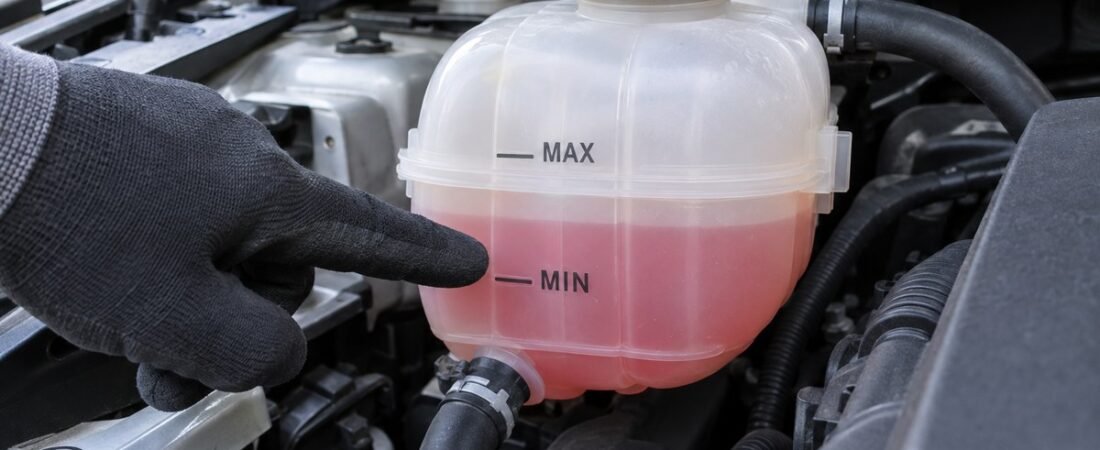
Your car most likely has a translucent plastic overflow or expansion tank near the radiator, often marked with a thermometer symbol or the word Coolant. It has MIN and MAX, or LOW and FULL, lines on the side (Firestone).
Some vehicles have more than 1 reservoir. Hybrids, turbocharged engines and EVs can have separate tanks for electronics or battery cooling, so don’t assume every translucent tank holds engine coolant (Chuck Anderson Ford). The manual’s diagram settles it in 30 seconds.
How to check coolant level: step-by-step
- Park on level ground. A sloped driveway tilts the fluid and gives you a false reading, so you want the car as flat as you can get it. Shift into Park, set the parking brake and turn the engine off.
- Let the engine cool completely. Plan on at least 2 to 3 hours after driving, or check first thing in the morning before you start the car.
- Open the hood and look and listen. If you hear hissing or bubbling, or see steam, close the hood and wait longer.
- Find the coolant reservoir. Use your manual if you’re not sure which tank you’re looking at. Wipe the side of the tank with a rag so the lines are easy to see.
- Read the level against the marks. With the engine cold, the fluid should sit between MIN and MAX (Firestone). Use a flashlight behind the tank if the plastic is cloudy.
- Check the color. Fresh coolant is clear and brightly colored: green, orange, pink, yellow or blue depending on the type. Brown, rusty or murky fluid, or visible particles, means the system needs service, not just a top-off.
- Test freeze protection, if you have a tester. Draw a sample from the reservoir and read it. A reading warmer than about -30°F suggests the mix has been diluted.
- Close everything and write it down. Note the date and level. If you’re topping off every 2 or 3 weeks, that’s a leak, not normal use.
How to top it off
If the level is at or below MIN, top it off with the engine cold. Remove the reservoir cap slowly, using a rag over it, and add coolant through a funnel until the level reaches the line marked for a cold engine. Don’t fill above MAX when cold; coolant expands as it heats, and overfilling can push fluid out of the overflow (Firestone).
Use the coolant your manual specifies. Coolant chemistry varies by manufacturer, and mixing incompatible types can cause the fluid to gel and clog passages (Firestone). Measure twice, buy once: check the spec in the manual before you’re standing in the store aisle.
If you buy concentrate, mix it with distilled water. The Motorcraft chart specifies distilled water for its 50/50 recommendation (Motorcraft). Tap water carries minerals that can leave deposits in the system. A gallon of distilled water runs about $1.49 to $2.49.
What your check tells you
- Between MIN and MAX, clean color: no action. Check again in 30 days or at your next oil change.
- Slightly below MIN, clean color: top off and recheck in 1 week. A small drop over months can be normal evaporation through the overflow.
- Low again within 1 to 2 weeks: look for a leak. Check under the car after it sits overnight for drips, look for crusty residue around hoses and the radiator, and watch for a sweet smell after driving. A shop pressure test usually runs $49.99 to $99.99.
- Murky, rusty or oily: book service. Oil in the coolant can point to a head gasket problem, and that’s not a top-off job.
Mistakes that cost you time and money
- Opening the cap hot. This is the mistake that injures people. If you’re in a hurry, you wait anyway.
- Topping off with plain water every time. It works in a roadside pinch, but repeated water-only top-offs weaken freeze protection right before winter.
- Mixing coolant types. If you don’t know what’s in your system, use what the manual specifies or have it flushed.
- Overfilling. Filling to the brim when cold leaves no room for expansion.
- Ignoring a slow loss. A slow leak doesn’t fix itself. Catching it at a $14.99 hose clamp beats finding it as an overheated engine dead in the water on the freeway shoulder.
- Skipping the flush interval. Coolant additives wear out. Service intervals vary widely by coolant type, so follow your manual rather than a generic mileage number.
Disposing of old coolant the right way
Used antifreeze is not something to pour out. The EPA says waste antifreeze should never go down storm drains or into surface water, because it causes serious water quality problems and can harm people, pets and wildlife (EPA). Used antifreeze can also pick up heavy metals such as lead, cadmium and chromium, which can make it a regulated hazardous waste, and many sewage agencies forbid putting it in sanitary sewers (EPA).
For a home mechanic, the process is simple:
- Drain or catch it in a sealed container with a tight lid. A clean, labeled plastic jug works.
- Label it as used antifreeze. Don’t mix it with oil, brake fluid or anything else, because mixed fluids can be harder to recycle.
- Store it out of reach of children and pets until drop-off.
- Take it to a recycler. Many auto parts stores, quick-lube shops and county household hazardous waste sites accept used antifreeze. Call ahead; acceptance varies by location.
- Clean up spills right away with absorbent material or cat litter, then bag it and take it with the jug.
Rules differ by state. Some states, such as Washington, regulate used ethylene glycol antifreeze as a dangerous waste unless it’s recycled, so check your local program before you drain anything.
The bottom line
A coolant check is 5 minutes, a flashlight and a cold engine. Read the marks, check the color, top off with the right fluid and watch for repeat losses. Do it now, before the first freeze, and add it to the same fall checklist you use for your battery and tires. That is how every On the Rise guide is meant to work: you check it once, you know where you stand, and you won’t be learning about your cooling system from a tow truck driver in January.
Go do the check this weekend. You’ve got this.
Johnny Chen, October 14, 2026