
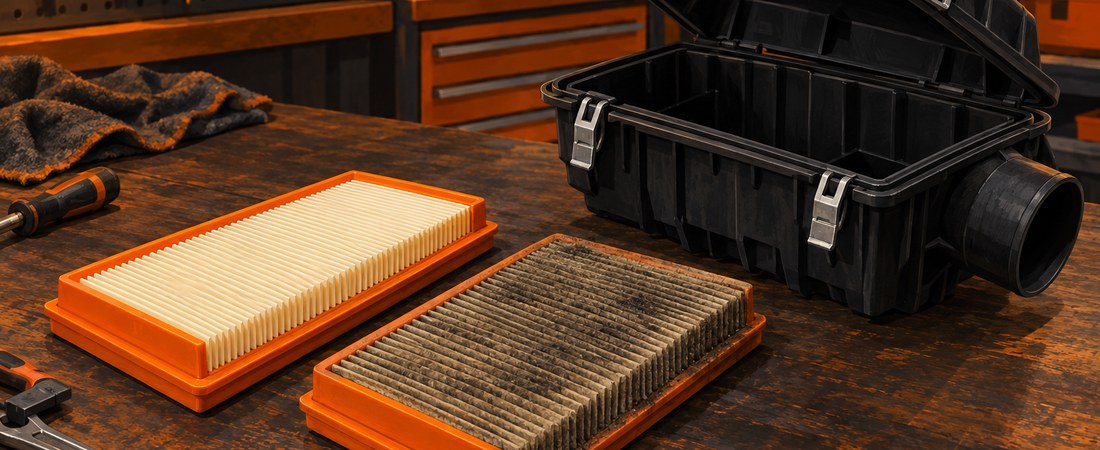
You’re at the shop for an oil change, and the service advisor walks out holding a dirty air filter like it’s evidence at a trial. “We recommend replacing this today.” The price is way more than the part.
Here’s the thing: you can do this yourself in about ten minutes, usually without tools. Let’s go.
What the engine air filter actually does
Your engine breathes air, a lot of it. The air filter sits in a plastic box between the outside world and your intake, catching dust, bugs and debris before they get into your engine. When it clogs, your engine has to work harder to breathe.
How often you really need to change it
Most manufacturers suggest every 15,000 to 30,000 miles, but AAA points out that dusty driving can clog a filter much faster, so the smart move is to inspect it rather than go only by the calendar (AAA).
One myth to drop: on modern fuel-injected cars, a dirty filter doesn’t really hurt your gas mileage. AAA explains that the old “change it often for fuel economy” advice made sense for carbureted engines, but Department of Energy testing found it doesn’t hold for modern cars. What you lose is some acceleration (AAA). So you don’t need to replace it early to save gas. You just shouldn’t ignore it.
What you need
- A new filter matched to your year, make, model and engine (check your owner’s manual or the parts store lookup)
- Your hands, in most cars
- A screwdriver or small socket set, only if your filter box uses screws instead of clips
- A rag or shop vac
A standard paper filter usually runs about $12 to $25, and a pricey “performance” filter won’t buy you mileage it can’t deliver (MotorJudge).
Step by step
1. Park, engine off, hood up. Let a hot engine cool for a few minutes.
2. Find the air filter box. It’s usually a black plastic box near the front or side of the engine bay, with a big intake tube running out of it. Your owner’s manual will show you if you’re unsure.
3. Open the housing. Pop the metal clips or remove the screws. Keep screws in a cup, not the engine bay.
4. Note how the old filter sits, then pull it out. Take a quick phone photo. The rubber rim and the side of the pleats matter.
5. Inspect it. Hold it up to a light. If light barely gets through, or it’s dark gray and full of debris, it’s due.
6. Clean the box. Wipe out leaves, dust and bugs, or hit it with a shop vac. Don’t let debris fall into the intake tube.
7. Drop in the new filter. Seat it the same way as the old one, with the rubber rim sealed all the way around.
8. Close it up. Refasten every clip or screw. A housing that isn’t sealed lets unfiltered air in, which defeats the whole point.
9. Start the car. It should sound and idle exactly like before.
Mistakes to avoid
- Buying by guess. Filters look similar but aren’t interchangeable. Confirm the part number.
- Leaving a clip undone. Run your finger around the whole seam before you shut the hood.
- Confusing filters. The cabin air filter (usually behind the glove box) is a different part that cleans the air you breathe inside the car. Worth checking too, but it’s a separate job.
When to hand it to a shop
If your filter box is buried under other parts, needs components removed to reach, or you find oil in the housing, stop and have a mechanic take a look. Oil in the air box can point to a separate engine problem.
The bottom line
Replacing an engine air filter is the easiest real maintenance job on your car. Check it at every oil change, replace it when it’s dirty, and keep the extra cash in your pocket.
Mechanic Guides — Johnny Chen, September 30, 2026